


Written by Thomas Fazi via UnHerd.com,
Mercenaries thrive while democracy dies…
Last week, Russia claimed to have taken control of the town of Bakhmut after an eight-month battle with Ukrainian forces, the longest and bloodiest fighting of the war so far. The assault, however, was not led by the Russian Armed Forces, but by a private army that has been fighting alongside regular Russian troops since the invasion: the infamous Wagner Group.
The Wagner Group has always been shrouded in mystery. In the early days of the war, reports emphasized the covert nature of its military operations, including a plot to assassinate Zelenskyy and his cabinet. Until recently, it was unclear whether a company registered under the name “Wagner” even existed.
That all changed in September 2022, when Yevgeny Prigozhin, a close ally of Putin, released a statement claiming he founded the group in 2014 to “protect Russians” when “the genocide of the Russian population of Donbas began “. Then, in January of this year, he decided to make it official, registering Wagner as a company and opening the headquarters of the “PMC Wagner Center” in St. Petersburg. It has made no secret of its activities: as the company’s name, which also appears on the group’s logo, makes clear, the Wagner Group is a PMC: a private military company, also known as a mercenary group. The Russian government was forced to acknowledge its existence. The underground status of the Wagner Group was officially discarded.
In many ways, Wagner’s emergence from the shadows symbolizes the changing nature of modern warfare, in which the traditional Clausewitzian paradigm—based on a clear distinction between public and private, friend and foe, civilian and military, combatant and noncombatant combatant—has given way to a much messier reality, in which state armies now regularly fight alongside paramilitary groups and private and/or corporate mercenaries. Today’s conflicts, even when violent in nature, often occur in a “grey area” below the threshold of conventional military action; adversary states increasingly confront each other through proxies or proxies—including private armies—rather than through their own armed forces. And this is not just a Russian issue: the increasingly central role of private military and security companies (PMSCs) in modern warfare is a global phenomenon.
Private armies have been around for centuries. In recent decades, the use of mercenaries was particularly widespread during the Cold War, especially in Africa, in the context of decolonization and subsequent civil wars. In particular, they were widely used between the 1960s and early 1980s by the West to prevent colonies from achieving independence or to destabilize or overthrow newly independent governments, such as the Democratic Republic of the Congo, the Republic of Benin and the Republic of Seychelles.
At the time, there was virtually no international legal framework regarding mercenarism. It was only in 1977 that the Geneva Conventions incorporated an international legal definition. A mercenary, he said, is anyone who is recruited to fight in an armed conflict, who takes an active part in hostilities and who is neither a national of a party to the conflict nor a resident of territory controlled by one. It was a very narrow definition, but one that, at the behest of newly independent nations, was specifically designed to address the West’s use of mercenaries against post-colonial governments.
This led to the appointment, in 1987, of a special rapporteur on the use of mercenaries; and then in 1989 to the International Convention Against the Recruiting, Use, Financing and Training of Mercenaries, which entered into force in 2001 and added language specifying that mercenaries were people who undermine legitimate governments , another clause that implicitly reflected the concerns of colonial countries. To this day, the Convention—which essentially copies the wording of the 1977 definition—represents the international legal definition of mercenarism.
As a result, during the 1990s there was a significant increase in the number of private military and security companies, which sought to distance their activity from the legal definition of mercenarism by presenting themselves as official business entities offering security services. “legitimate” security and defense. allegedly distinguished from that of rogue mercenary groups. And they generally did it successfully. During this decade alone, PMSCs trained the militaries of 42 nations and participated in more than 700 conflicts.
There was also a broader backdrop to this growth. The growing influence of the neoliberal logic of economic rationalization and deregulation during the 1990s also pushed states to privatize and outsource many government functions and services, including war. Security came to be perceived as a commodity, a service like any other that could be sold and bought on the market. This was also part of a wider push towards the transfer of national prerogatives to supra-state or, as in this case, non-state actors as a way of moving the decision-making process away from democratic institutions. This trend was exacerbated by the overall drawdown of national military forces, which also expanded the recruitment pool for PMSCs.
Although PMSCs began by mainly selling their services to developing countries and so-called failed states facing political crises, by the mid-1990s Western governments, particularly the US, also began using them. By hiring them to support, train, and equip the military and security forces of friendly governments—especially in the former Yugoslavia—Western powers were able to advance their interests and foreign policy agendas while avoiding entangling se in unpopular conflicts, and even circumventing international limitations on the deployment of troops. By the end of the decade, NGOs (such as Oxfam) and even the United Nations had also come to rely heavily on PMSCs for their own security and even peacekeeping missions.
In this sense, PMSCs did not so much replace the role of states as integrate them. In some cases, they even strengthened the military power of the state, allowing governments to engage in forms of warfare that they would otherwise have been prevented from undertaking for fear of provoking a conventional military response from more powerful states, while escaping public scrutiny. The activities of the Wagner Group in several African and Middle Eastern countries—such as Syria, Libya, the Central African Republic, and Mali—are a good illustration, insofar as they granted Moscow a degree of plausible deniability about the their foreign interventions and alleged human rights. abuses committed by Wagner.
Over the years, various efforts have been made to regulate this new phenomenon at the international level, eventually leading to the creation of a UN Working Group on the Use of Mercenaries in 2005. But these bodies, in general, have failed. Today, the industry remains largely unregulated and operates in a de facto legal vacuum. PMSCs cannot be considered support soldiers or militias under international humanitarian law as they are not part of the military or chain of command, but neither can they be considered mercenaries under the narrow legal definition adopted by the UN . In the current conflict in Ukraine, for example, the Wagner Group cannot be considered a mercenary group by legal standards simply because its members are nationals of one of the parties to the conflict.
These private military companies remain largely unaccountable, characterized by a “fundamental lack of transparency around and supervision [their operations]”, as the UN Working Group noted in 2021. Indeed, it suggested that this is sometimes “done precisely with the ominous aim of providing a ‘plausible denial’ of direct involvement in a conflict”. Greater regulation would be welcome, of course, but it would not change the fact that corporate armies inherently undermine democratic accountability, arguably one of the reasons that makes them attractive to states in the first place.
More fundamentally, what we are dealing with here is the legalization and normalization of mercenarism. The only real difference between traditional guns-for-hire and PMSCs is that the latter are usually legally incorporated companies with corporate organizational structures. This gives them legitimacy and, theoretically, makes it easier to monitor their actions and prosecute them. But in the end they remain, for all intents and purposes, “new forms of mercenaries”, as even the UN General Assembly argued a few years ago.
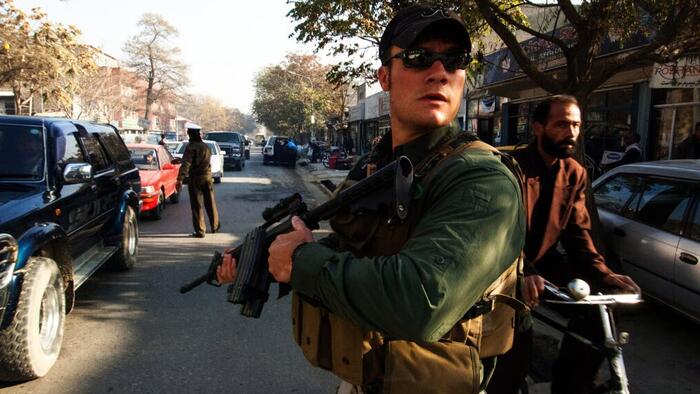
Crucially, the UN report recognizes that the private security and military industry is a global and growing phenomenon. While the focus today is on Wagner, the real mercenary boom occurred during the US-led military interventions in Afghanistan and Iraq. In both cases, the US relied heavily on PMSCs such as DynCorp and Blackwater (now known as Constellis). In fact, at times, the number of contractors on the ground actually outnumbered US troops. In 2006, it was estimated that there were at least 100,000 PMSC employees in Iraq working directly for the US Department of Defense.
And like Wagner today, they were involved in various human rights abuses in the country. Blackwater, for example, the most prominent PMSC in Iraq, was involved in the massacre of 17 Iraqi civilians in 2007 (which led to the conviction of four Blackwater employees), while other PMSCs were involved in the Abu Ghraib prison scandal in Iraq. although none were prosecuted) and are alleged to have participated in the CIA’s “extraordinary rendition” program: the kidnapping and forcible removal of individuals to locations known for torture. Despite these obvious failures, by the summer of 2020, the US had more than 20,000 contractors in Afghanistan, roughly twice the number of US troops. Before that, in 2017, Erik Prince, founder of Blackwater, had proposed to completely privatize the war effort there.
What could inspire such a discovery? Well, while the Iraq and Afghanistan conflicts are generally considered a strategic mistake for the US, not to mention a humanitarian tragedy, they were a boon to the PMSC sector: until 2016, the US State Department spend $196 billion on PMSCs. contracts for the Iraq war and $108 billion for the Afghan war. And business hasn’t slowed down: by 2022, the PMSC sector, whose largest companies are now US or British, was valued at $260 billion and is expected to reach a value of around $450 billion of dollars by 2030. The world’s largest PMSC, the UK-based G4S alone employs over 500,000 people and is present in over 90 countries.
Should we be surprised? Ultimately, the growth of the PMSC sector is just one more example of how the economic transformations of recent decades have blurred the boundary between the public and private-business spheres to the point of making them indistinguishable. The result has been the rise of a Leviathan state-owned company that has swallowed up all sectors of the economy (healthcare, banking, energy, technology) and has now also taken over the battlefield, at the expense of the democratic control and supervision. . This applies to Russia as much as to Western countries. If the conflict in Ukraine has taught us anything, it’s that war today is bigger business than ever. No wonder peace, in Ukraine or elsewhere, seems constantly out of reach.
***
Do you like what you read? Join like-minded readers who support our journalism, read unlimited articles, and enjoy other subscriber-only benefits.

 English
  Español de Venezuela