


The superpathogens of E. Coli you should know
Written by Dr. Sean Lin and Jacky Guan via The Epoch Times (emphasis ours),
Foodborne illness, also known as food poisoning, is a serious public health problem. Every year, they make 48 million people sick, hospitalize 128,000 and cause the death of 3,000. Pathogenic E. coli is one of the most common known foodborne pathogens. However, the severity of several strains of E. coli varies enormously, and the public should be cautious about a type of E. coli especially dangerous.
E. Coli 101
Escherichia coli, also known as E. coli, is one of the most common types of bacteria known to mankind. From helping with digestion in the stomach to being a producer of artificial insulin, bacteria discovered in 1885 have been studied countless times and improved our understanding of the microscopic world.
The E. coli that we infamously know from the news belongs to the enteropathogenic E. coli (EPEC) group and are pathogens responsible for food poisoning. Foodborne illnesses also include salmonella and norovirus (responsible for recent cruise ship outbreaks). An E. coli infection usually occurs when a person comes into contact with contaminated food, animals, or water. It usually only causes mild abdominal pain or brief diarrhea. Other symptoms include stomach cramps, nausea, vomiting and fever.
Typical treatment usually includes rest, hydration, and nutritional support. The disease is usually self-limiting, as the body can usually eliminate it. The use of antibiotics is common in the treatment of E. coli, but antibiotic resistance is also a problem worldwide. However, severe forms of E. coli are the variants of Shiga toxin-producing bacteria that can have dire consequences.
STEC variants severely damage the intestinal linings and kidneys
The variants of E. coli that produce Shiga toxins (Stx) are called Shiga Toxin-producing E. coli, or STEC. They have gained a lot of attention in recent decades as they are known to cause serious illness.
STEC belongs to the EPEC group. STEC strains are capable of producing toxins called Shiga toxin type 1 (Stx1), type 2 (Stx2), or both, encoded by the stx1 and stx2 genes, respectively.
The toxins are named after Kiyoshi Shiga, who first described the bacterial origin of dysentery caused by Shigella dysenteriae. Historically, the toxin produced by E. coli was named Shiga-like toxin (SLT). Shigella dysenteriae and STEC are now considered the most common sources of Shiga toxins.
Symptoms of an STEC infection include abdominal pain and watery diarrhea. There are also severe, possibly fatal cases characterized by hemorrhagic colitis.. These types of E. coli are also called enterohemorrhagic E. coli (EHEC). Shiga toxins are also associated with hemolytic uremic syndrome (HUS).
In particular, STEC O157:H7 and STEC O104:H4 are the two most notorious STEC strains. You could say that these STEC groups are like super soldiers of E’s army. coli
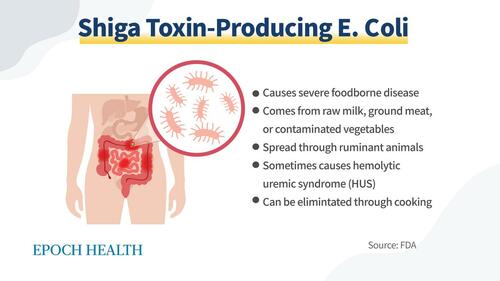 Shiga toxin-producing bacteria are strains of E. coli that does not want to be found. (The Epoch Times)
Shiga toxin does most of its work in small blood vessels, as it is quite ineffective in large vessels such as veins and major arteries. This is how the toxin can specialize against the digestive tract, kidneys and lungs. For example, Shiga toxins are good at destroying clusters of nerve endings or small blood vessels in the kidneys, which can lead to kidney failure and even HUS. It can also severely damage the lungs, so food poisoning associated with Shiga toxins is often also associated with lung and nervous system damage.
Read more here…

 Español de Venezuela
  English