


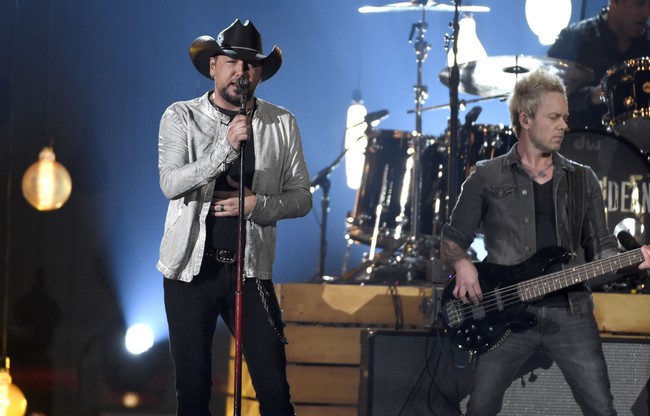
There are a few different impressions you get from a recent piece in the New York Times covering the experiences captured at a music festival held last month. I say “impressions” because there are no real revelations shown or clear conclusions reached in the piece. Instead, one often sees the practice of a cloistered city elitist making “breakthroughs” in the pass country, as well as muddled details as the concertgoers were not producing the expected results.
Journalist Richard Fausset attended the two-day Rock The Country concert festival in South Carolina, one of seven stops featuring a wide variety of primarily country music acts headlined by Kid Rock and Jason Aldean. Fausset toured the venue, hung out with tailgaters and explored backstage. While he may not quite fall into the wide-eyed wonder of the previously unexplored facet of the South, as some journalists do, sounding like Dian Fossey walking into the gorilla-filled fog, he nonetheless shows a touch of confusion
Fausset is at times conflicted as he reports on a sports venue with contradictory patterns in front of him. This kind of curious discovery can only come when you begin your quest with a preconceived notion of what to expect, and you get the palpable feeling that, while it describes perfectly relatable scenes, it feels unbalanced in the mix.
He wants to give us a look at “the MAGA movement in pure party mode”, although it is a meeting about music, not politics. There is no doubt that it appeals to conservative-leaning people, but it is not the driving force. Fausset tilts his hand because it often presents a paradox, as seen in its title; talks about 'joy' and rage', 'angry rebellion' and 'beer-drinking pursuit of happiness'.
However, it never delivers on that promise of rage and anger on display. A concert player mentioned the need for a civil war. a boy (This is significantly surpassed by an opening act where the singer implored the crowd to reach out to those with political differences and bring a message of peace.) Fausset also saw a collection of T-shirts in the crowd with what he described as politically incorrect slogans: “Taxes are gay“; “amosexual“; and “I'm voting CONVICTED FELON 2024“. (Insert mine GASP! → here.)
You feel like this photo was being triggered @NYTimes on several levels. pic.twitter.com/WKNNDjM3kU
— Lie-Able Sources (@LieAbleSources) August 13, 2024
What is clear is that the Times article indicates that it makes no sense to them that people with different positions on issues can still come together and enjoy things as a group. The bottom line here is that we're supposed to be at each other's throats and yet he saw the differences without conflict. In the parking lot, he encountered people who were both pro-life and pro-choice. He witnessed religious expressions as well as beer drinking and passion. The Tories have been “proudly” against drug use, he says, but there was one busy cannabis shop and another selling mood-altering gummies. Richard seems perplexed that right-of-center people can know how to have fun.
What is clear is that these apparent conflicts among the crowd were not expected. It wasn't just “The faithful of MAGA” was expected to behave a certain way, but the idea that people with different opinions could manage to not only get together, but get along and have fun – with each other – was baffling. But… but you're angry…!it is the undercurrent that is felt in the approach. How these people can hold different points of view and not be outraged is a mystery to Fausset.
This has been my experience when I am with like-minded people. I can stand with those who disagree on an issue and it is entirely possible to debate our positions and listen, without condescension. I can sit in the tavern and have a quiet debate about an issue, and even if no agreement is reached, we clink glasses. Outrage is not the default with those on the right, it has been my experience. Here is an anecdote:
One night I was in the barrel, sitting with others outside enjoying beers and cigars and laughing. One of our favorite servers came off duty and sat with us for a spell. Some topic came up and we were discussing it when he noticed. “Holy cow, you are all conservatives???” We shrugged, collectively; i guess so She got up to leave at this result, which puzzled us. She believed that because she was on the left, to any degree, she was not welcome.
To a man, we were all confused by this reaction. The consensus at the table was, so what?! It took a few moments, but we calmed her down and she joined us at the table and I bought her a drink. You could tell he wasn't expecting a calm, accepting answer, and it took him a while to accept that reality. I have seen this mentality play out over the years; Every time I hear a story of a friendship broken by politics, it's uniformly a leftist who says there's no way I'm going to tolerate a conservative/Republican/Trump supporter.
This is reflected in the words of Elvie Shane, that singer who talked about looking for our political opponents. “If you love them, you are the greatest man; you make the phone call and say, “Hey, look, I know we disagree.” But I still love you.” I know this is the mindset of many on the right. It comes as a surprise to the New York Times and others in the press, who have been insisting for years that they must look down on others and have been training their audiences to be combative at the Thanksgiving table.
Richard Fausset seems genuinely surprised by the attitudes and behavior of the Tories at this event. See what happens when the media meets conservatives in person!

 Español de Venezuela
  English