


A rebel mercenary commander said on Saturday he had ordered his mercenaries to halt their march towards Moscow and retreat to Ukrainian countryside, appearing to defuse a dramatic escalating crisis that has posed the biggest challenge to President Vladimir Putin in his more than two decades in power.
Moscow had prepared for the arrival of forces from the Wagner Group, a private army led by Yevgeny Prigozhin who has been fighting alongside regular Russian troops in Ukraine, setting up checkpoints with armored vehicles and troops on the southern edge of the city. Plaça Roja was closed and the mayor urged motorists to stay off some roads.
But Prigozhin announced that while his men were only 200 kilometers (120 miles) from Moscow, he decided to turn them back to avoid “shedding Russian blood”.
He did not say whether the Kremlin had responded to his demand to remove Defense Minister Sergei Shoigu. There was no immediate comment from Putin’s government.
The announcement followed a statement from the office of Belarusian President Alexander Lukashenko saying he had negotiated a deal with Prigozhin after discussing the issue with Putin. Prigozhin agreed to halt the advance on a proposed deal that included security guarantees for Wagner’s troops, Lukashenko’s office said, without elaborating.
Putin had promised harsh consequences for the organizers of the armed uprising led by his former protégé, who brought his forces. outside Ukraineseized a key military installation in southern Russia and advanced on Moscow.
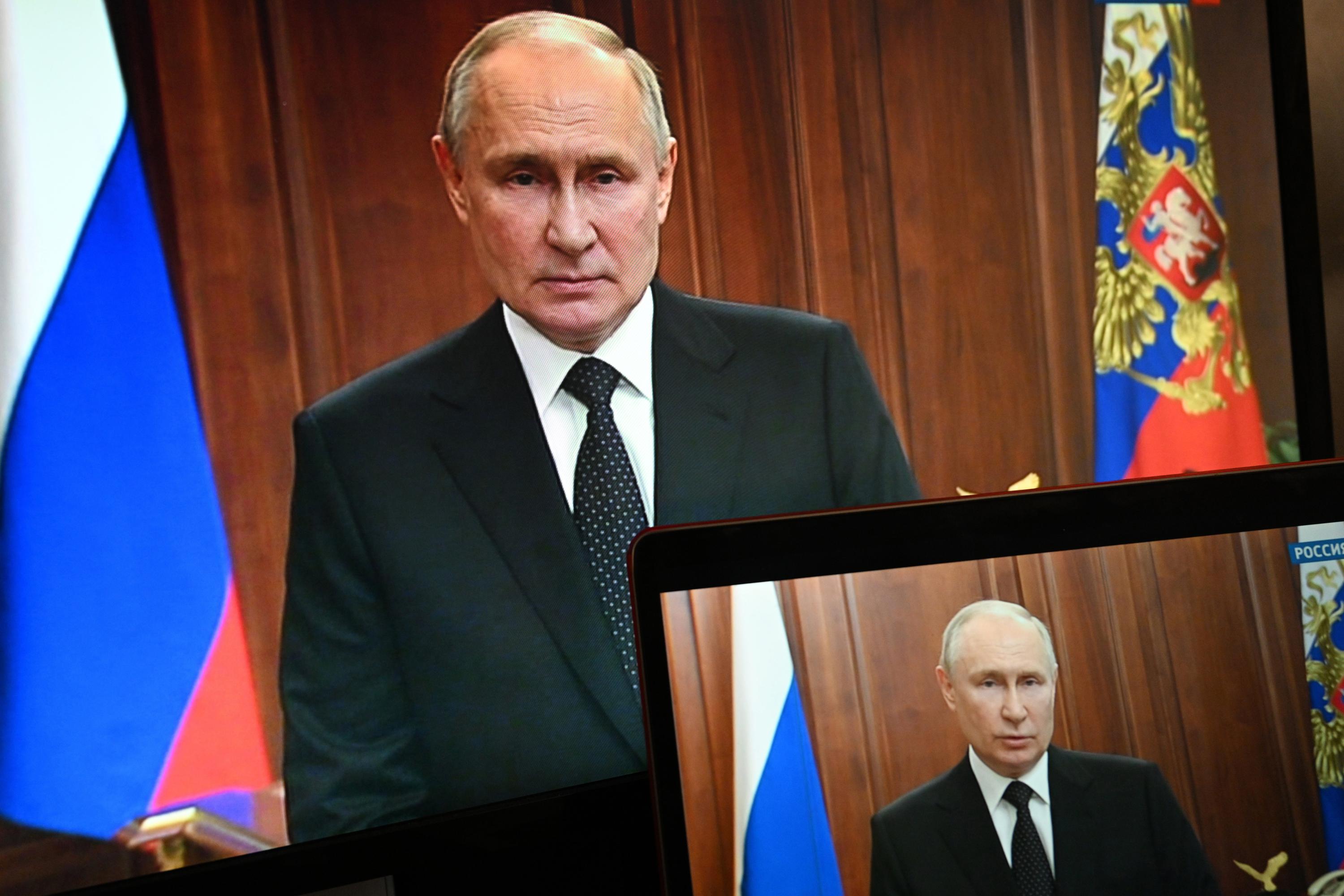
In a televised address to the nation, Putin called the rebellion “betrayal” and “betrayal.”
“All those who prepared the rebellion will suffer inevitable punishment,” Putin said. “The armed forces and other government agencies have been given the necessary orders.”
It was not immediately clear what concessions, if any, Putin might have made to persuade Prigozhin to halt his departure.
If he accedes to Prigozhin’s demand to oust Shoigu, Prigozhin would emerge from the crisis as the clear winner in a major blow to Putin’s authority.
If Prigozhin agrees not to press the suit, Putin could award him more lucrative government contracts like those on which he has built his fortune in the past.
However, it would be inconvenient and politically damaging for Putin to back down after calling Prigozhin a backstabbing traitor.
Some observers speculated that Prigozhin might make concessions such as bringing the Wagner Group under federal authority, or that he might move the force’s activities to Africa, where his mercenaries have been active in recent years.
Early Saturday, Prigozhin’s private army appeared to be in control of the military headquarters in Rostov-on-Don, a city 660 miles (more than 1,000 kilometers) south of Moscow that directs Russian operations in Ukraine. said the British Ministry of Defence.
Wagner’s troops and team were also in Lipetsk province, about 360 kilometers (225 miles) south of Moscow, where authorities were “taking all necessary measures to ensure the safety of the population,” he said. say regional governor Igor Artamonov, via Telegram.
Authorities declared an “anti-terrorist regime” in Moscow and its surrounding region, beefing up security and restricting some movements. On the southern outskirts, troops set up checkpoints, set up sandbags and set up machine guns. Crews dug up sections of road to slow the march.
Moscow Mayor Sergei Sobyanin warned that traffic could be restricted in some parts of the capital and declared Monday a non-working day for most residents.
The dramatic developments came exactly 16 months after Russia launched its full-scale invasion of Ukraine, Europe’s biggest conflict since World War II, which has killed tens of thousands, displaced millions and reduced cities to rubble.
Ukrainians hoped that Russian infighting would create opportunities for their army to retake territory occupied by Russian forces.
Ukrainian President Volodymyr Zelenskyy said Moscow was suffering from “large-scale weakness” and that Kiev was protecting Europe from “the spread of Russian evil and chaos”.
The Federal Security Service, or FSB, called for Prigozhin’s arrest Friday night after he declared armed rebellion.
Prigojin He said earlier on Saturday that his fighters would not surrender as “we do not want the country to continue living in corruption, deception and bureaucracy”.
“On treason to the motherland, the president was deeply mistaken. We are patriots of our land,” he said in an audio message on his Telegram channel.
Prigozhin said he had 25,000 troops under his command and urged the army not to offer resistance.
He posted a video of himself at the military headquarters in Rostov-on-Don and claimed that his forces had taken control of the airfield and other military facilities in the city without any deaths or “a single shot “. Other videos on social media showed military vehicles, including tanks, in the streets.
The rebellion came as Russia is “fighting the toughest battle for its future,” Putin said, with the West piling sanctions on Moscow and arming Ukraine.
“The entire military, economic and information machine of the West is fighting against us,” Putin said.
State-controlled television channels led their newscasts with Putin’s statement and reported on the tense situation in Rostov-on-Don. Some showed videos on social media of residents denouncing Wagner’s troops.
The broadcasters also carried statements from senior officials and lawmakers expressing support for Putin and condemning Prigozhin.
In announcing the rebellion, Prigozhin said he wanted to punish Shoigu after he accused Russian government forces of attacking Wagner’s field camps in Ukraine with rockets, helicopter gunships and artillery. He claimed that “a large number of our comrades were killed.”
Prigozhin said his forces shot down a Russian military helicopter firing on a civilian convoy, but there was no independent confirmation.
He also alleged that General Valery Gerasimov, chief of the General Staff, ordered the attacks after a meeting with Shoigu in Rostov, where they decided to destroy the military contractor.
The Ministry of Defense denied attacking Wagner’s fields.
Prigozhin, 62, a former convict, has long ties to the Russian leader and won lucrative Kremlin catering contracts that earned him the nickname “Putin’s Chef.”
He drew attention in the United States when he and a dozen Russian citizens were accused of operating a covert social media campaign aimed at fomenting discord before Donald Trump won the 2016 presidential election. the Wagner mercenary group, which sent military contractors to Libya, Syria, several African countries and finally Ukraine.
After Putin’s speech, in which he called for unity, officials sought to reiterate their loyalty to the Kremlin and urged Prigozhin to back down.
Vyacheslav Volodin, speaker of the lower house of parliament, said lawmakers “stand for the consolidation of forces” and support Putin.
Foreign Ministry spokeswoman Maria Zakharova echoed that, saying in a Telegram post that “we have one commander-in-chief. Not two, not three. One.”
Ramzan Kadyrov, the strongman leader of the Chechen region who used to stand by Prigozhin in his criticism of the military, also expressed his full support for “every word” of Putin.
“The riot must be suppressed,” Kadyrov said.
Even with the matchup seemingly off, it seemed likely to make it even more difficult The Moscow War Effort as Kiev forces probed Russian defenses in the early stages of a counteroffensive.
Wagner’s forces have played a crucial role, capturing the eastern city of Bakhmut, an area where the bloodiest and longest battles have taken place. But Prigozhin has increasingly criticized the military brassaccusing him of incompetence and of starving his troops of ammunition.
Prigozhin’s actions could have important implications for the war. Orysia Lutsevych, the head of the Ukraine Forum at the Chatham House think tank in London, said the infighting could create confusion and a possible split among Russian military forces.
“Russian troops in Ukraine may be operating in a vacuum, with no clear military instructions and doubts about who to obey and follow,” Lutsevych said. “This creates a unique and unprecedented military opportunity for the Ukrainian military.”
Ukrainian soldier Andrii Kvasnytsia, who was attending the funeral of a comrade, said Prigozhin’s intentions towards Ukraine might be worse than Putin’s, but that the infighting would still benefit the country.
Western countries followed developments closely. US Secretary of State Antony Blinken spoke with his counterparts from the other G7 countries and the European Union’s foreign affairs representative, his spokesman said, adding that Blinken “reiterated that U.S. support for Ukraine will not change.”
Latvia and Estonia, two NATO countries that border Russia, said they were increasing security at their borders.
The Kremlin said Putin spoke by phone with the leaders of Turkey, Belarus, Kazakhstan and Uzbekistan about the events.
Although there was speculation that Putin had left Moscow, his spokesman Dmitry Peskov denied this.
___
Associated Press writer Danica Kirka in London contributed.
___
Follow AP coverage of the war in Ukraine at https://apnews.com/hub/russia-ukraine-war

 Español de Venezuela
  English