


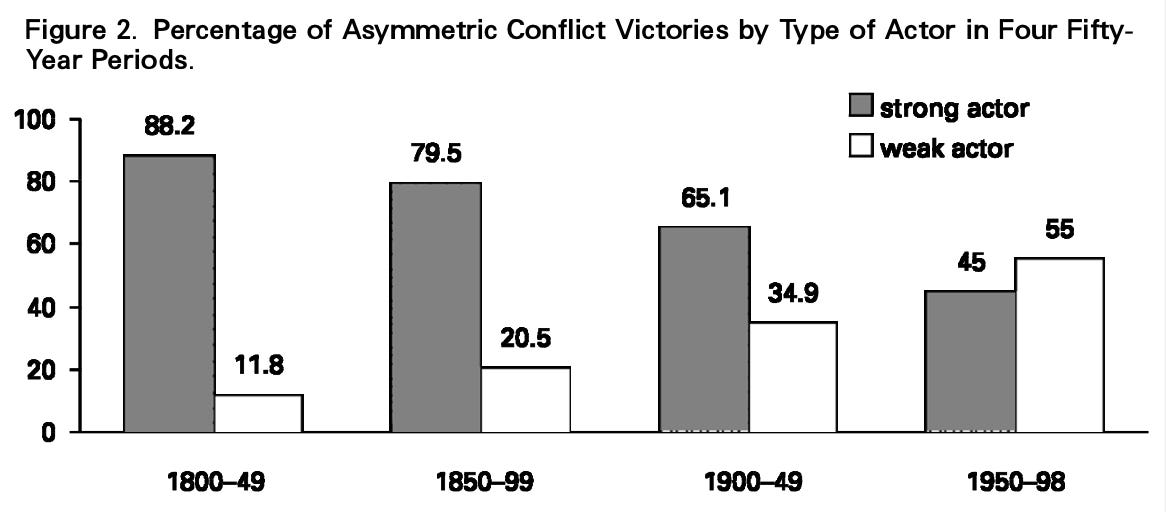
Over the last few centuries, powerful states have gotten worse at winning wars against weaker adversaries. The chart below presents one such analysis that demonstrates this development in international politics.
Almost all statistical work in international relations should be taken with a grain of salt, but the results here are almost certain. At one point, Western nations dominated the vast majority of the world’s land surface. Today, the US can struggle for decades to impose its will on a poor nation on the other side of the world and end up leaving in disgrace.
It seems unlikely that there is a technological reason for this change. If anything, strong countries should better achieve their goals. Sure, insurgents now have things like cell phones and IEDs, but that’s unlikely to be as important as the new tools available primarily to rich states, such as nuclear weapons, precision bombs, and advanced satellite and surveillance technology .
The mention of nuclear weapons in the last sentence should provide a clue as to where I’m going with this. The use of nuclear bombs in a conflict like Afghanistan or Iraq is unthinkable. This provides a clear example of how new humanitarian ideas make wars harder to fight and win.
If we look at the US and Israeli wars in the Middle East in recent decades, it is remarkable how few people have been directly killed by the stronger side. I’ve gathered the numbers for eight conflicts below.
Let’s put these numbers in historical perspective. Just looking at the civilians who died because of direct military action, in WWII Germany lost 1.5-3 million and Japan lost up to 800,000. Even after World War II, millions of civilians died in korea These are all interstate conflicts, but that’s not the point, as Western countries used to be much more willing to do this. commit atrocities also when suppressing insurrections.
It would be nice to believe that there is no trade-off between protecting innocent life and winning wars. My theory of the origins of counterinsurgency The doctrine is that it emerged in the late 2000s as a way to tell policymakers what they wanted to hear, which is that you defeat an enemy and develop a stable state primarily by winning civilians over to your side, and winning civilians over to your side . looking out for their objective interests. However, this would be quite surprising if true. Since insurgents hide among civilians and live off the local economy and infrastructure, there will often be times when killing them or hindering their operations will need to risk harming the general public. How much harm he is willing to inflict on non-combatants is a political and moral question.
The basic idea behind COIN was that third world populations will like you if you’re nice to them and hate you if you’re mean to them, and you have to do things to make them like you. This is not completely crazy, since all things being equal, it is much better to have the people on your side. But insurgents tend to have little qualms about killing collaborators, and sometimes even their families, which shapes the incentive structure civilians face when deciding which side to support. A better model is that some places produce moves that invaders and occupiers don’t like no matter what, and the only question is whether you scare or kill them enough to get them to do what you want, or whether you neutralize the threat they represent. Conflict is generally caused by opportunity, not grievance, that’s what I’ve been saying for years that people predicting an american civil war don’t know what they are talking about.
Of course, just because Western wars kill very few individuals directly doesn’t mean they aren’t a big deal, as many more people can die as a result of the chaos and disorder they unleash. While fewer than 20,000 civilians were killed by coalition forces in Iraq between 2003 and 2011, the war’s total casualties are in the hundreds of thousands. In Libya, the coalition’s bombing campaign claimed very few lives, but sparked a bloody civil war that has raged ever since. Bringing enough force to overthrow a government, but not enough to create order, can give you the worst of all worlds.
Of course, the US can afford to fight with one hand tied behind its back. None of these places really matter to us, and terrorism has always been such a small risk that it can be treated as one fake problem It’s actually an interesting moral question whether it would be worth forcing third world nations to accept western institutions at gunpoint, which would clearly be better for them in the long run, but the point is moot if we’re not willing. use the means to do so. The delusion of the neocons and COIN types was that this could be achieved just by spending a lot of money instead of using the kind of tactics that Western leaders deployed when they used to win their wars.
Israel is a different story, though. Their opponents represent an existential threat to their way of life. Despite this, the country has been remarkably restricted. All the Palestinian civilians killed in the last fifty years do not even come close to the number of lives lost in the US war against ISIS, let alone World War II. This is primarily because Israel faces much greater scrutiny than most other nations in similar circumstances.
That said, Israel doesn’t strike me as suicidal. The recent attack by Hamas has shaken the current conflict out of the now default war of choice framework and has clearly turned it into a war of necessity. I hope Israel will do whatever is necessary to at least dismantle Hamas or establish a buffer zone between it and the people of Gaza. If he doesn’t, the problem will get worse and the Israelis will find themselves in exactly the same position a few years later. It would be nice to believe that the Palestinian conflict could be resolved if the stronger side were more accommodating to its enemy. But there is little in the history of the war, and certainly nothing in Hamas doctrine, to suggest that this is a viable path. The choice facing Israel is tragic, however much those who call for moderation are in denial about that fact.

 English
  Español de Venezuela